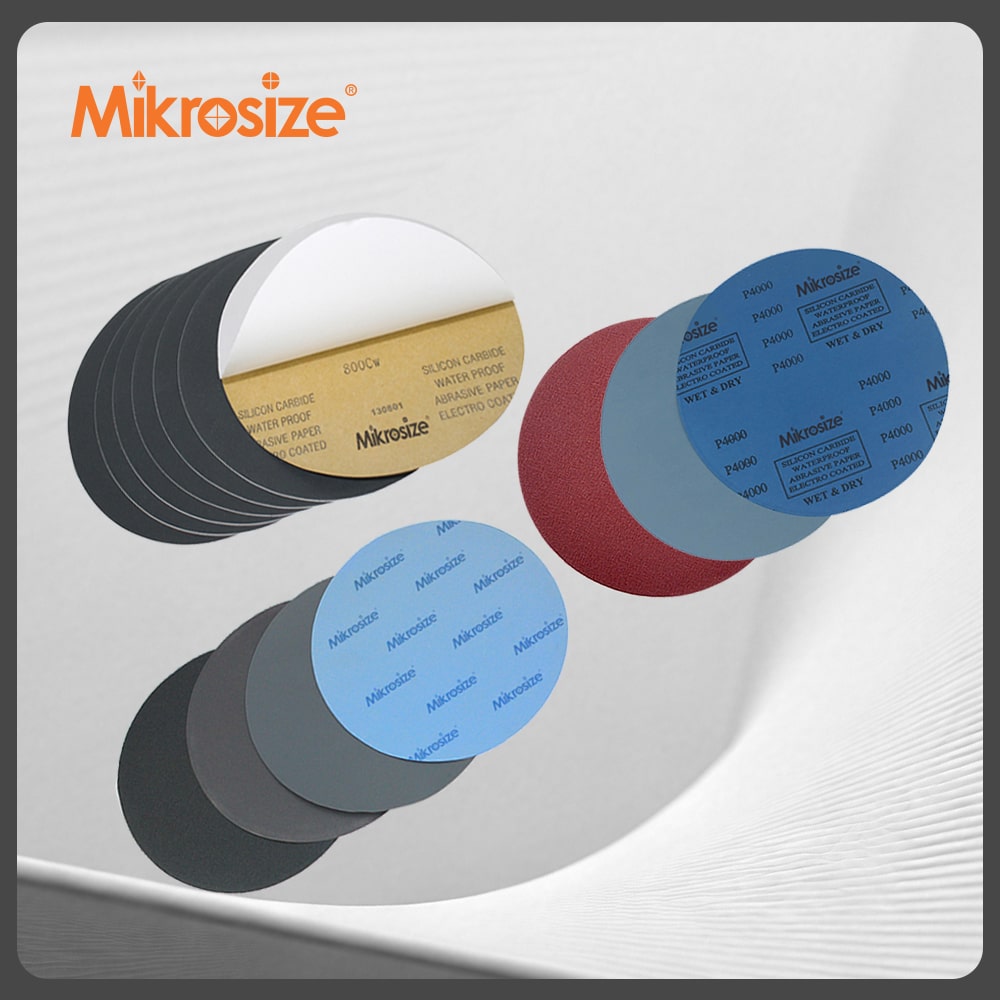
Currently, the global grading and quality standards for metallographic abrasive paper are primarily centered around the FEPA (Federation of European Producers of Abrasives) standard. China’s national standard (GB/T) fully adopts the FEPA standard system, while a small number of products conforming to the ANSI (American) and JIS (Japanese) standards (marked with # mesh sizes) still exist on the market. Clearly understanding the differences and correspondences between these standards is crucial to avoid selection errors.
(I) FEPA Standard: Global Mainstream, Preferred for Precision Work
The FEPA standard is currently the most authoritative and widely used abrasive grain size standard. It comprises two systems, the F series and the P series, which strictly differentiate between bonded abrasives and coated abrasives. Among these, the P series is the dedicated standard for metallographic abrasive paper:
FEPA P Series (for Coated Abrasives): Specifically designed for coated abrasives such as sandpaper and abrasive belts. It is the core standard for metallographic abrasive paper, denoted by “P” followed by a number (e.g., P80, P600, P2000). Its grading logic is centered on the median grain size (D50), with a very narrow particle size distribution, emphasizing scratch uniformity and precision grinding performance. The particle size ranges from P12 (coarsest) to P2500 (finest); the larger the number, the finer the abrasive grain. P-series abrasive paper features sharp, uniformly distributed grains and is the standard choice for metallographic preparation (rough grinding → medium grinding → fine grinding), effectively ensuring consistency and repeatability in sample preparation.
FEPA F Series (for Bonded Abrasives): Specifically designed for bonded abrasives such as grinding wheels and cutting discs, denoted by “F” followed by a number (e.g., F80, F220). Its grading logic is centered on sieve mesh aperture, with a relatively wider particle size distribution, emphasizing the strength and cutting efficiency of the abrasive grains. The particle size ranges from F4 to F1200. Although some F-series abrasive paper can be used for rough grinding, its insufficient grain uniformity leads to deeper scratches, making it unsuitable for precision metallographic grinding. It can only be used for rapid material removal during the rough grinding stage after cutting.
(II) China National Standard (GB/T): Fully Aligned with FEPA Standard
China’s national standards concerning metallographic abrasive paper are primarily formulated based on the FEPA standard, without an independent dedicated designation. The core standards include:
GB/T 9258-2018 “Coated Abrasives – Grain Size Analysis of Abrasive Grains”: Fully adopts the FEPA P-series system, specifying the grain size classification and testing methods for coated abrasives (sandpaper, abrasive belts). It serves as the core basis for quality inspection of metallographic abrasive paper.
GB/T 2476-2018 “Conventional Abrasives – Designation”: Adopts the FEPA F-series system, applicable to the grain size classification of bonded abrasives such as grinding wheels and cutting discs.
JB/T 7498-2017 “Coated Abrasives – Abrasive Paper”, JB/T 7499-2017 “Coated Abrasives – Waterproof Abrasive Paper”: Further specify the technical requirements and inspection rules for metallographic abrasive paper, including specific indicators such as substrate flatness, abrasive grain adhesion, and water resistance.
(III) ANSI/JIS Standard (# Mesh Size): Industrial Grade, Unsuitable for Precision Metallography
Commonly found “#” sandpaper (e.g., #80, #600, #2000) conforms to either the ANSI (American) or JIS (Japanese) standard, denoted by “#” followed by a number. This essentially indicates the mesh size, i.e., the number of openings per square inch of the sieve. This standard defines only the average grain size, with a relatively wide particle size distribution and poor consistency. It is suitable for general industrial sanding (e.g., woodworking, hardware deburring) but is unsuitable for precision metallographic grinding. Even if the number appears close to a P-series designation (e.g., #600 ≈ P600), its grain uniformity and sharpness are far inferior to those of P-series abrasive paper. Using it can easily lead to deep scratches and cross scratches on the sample surface, affecting the observation of the microstructure.

-150x150.jpg)