
Polarized light microscopy is designed to observe specimens that are visualized primarily due to their optical anisotropy. A polarized light microscope must be equipped with both a polarizer and an analyzer (a second polarizer): the polarizer is placed somewhere in the light path before the specimen, and the analyzer is positioned in the optical path between the rear aperture of the objective lens and the observation tube or camera mount. Image contrast arises from the interaction of plane-polarized light with a birefringent (or doubly refracting) specimen, which generates two separate light wave components polarized in mutually perpendicular planes. These two components propagate at different velocities that vary with their direction of travel through the specimen. Upon exiting the specimen, the components develop a phase difference; when they pass through the analyzer, they undergo constructive and destructive interference, enabling the recombination of light.

Birefringence: The Key to Polarized Light Microscopy
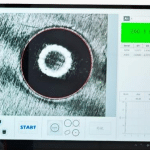
Birefringent objects possess the property of splitting a single light beam into two distinct beams via refraction. Birefringent materials include substances with highly ordered molecular structures, such as calcite or boron nitride crystals. Biological specimens (e.g., cellulose or starch) are also birefringent. The combination of birefringence and linearly polarized light enables microscopic observation by creating interference between the two separated light beams, producing colorful effects such as interference rings and structural luminescence.

Alignment and Light Path of Polarized Light Microscopy
A conventional light microscope requires at least two additional components to perform polarized light microscopy. Linearly polarized illumination is essential for detecting birefringence. Therefore, two polarizing filters must be inserted into the microscope’s light path. The polarizer generates polarized light to illuminate the specimen, and the second polarizing filter (the analyzer) restricts the detected light to the refracted component.
The polarizing filters must be oriented at 90° to each other to achieve the so-called extinction position (complete darkness). When the filters are set to this position, no light reaches the camera or eyepiece, and the image appears dark. Achieving extinction is a critical step in polarized light microscopy, as it ensures that only light whose plane of polarization has been altered by the specimen becomes visible.

Polarizer and Analyzer
Light passing through the first polarizing filter is converted into linearly polarized light. If the linearly polarized light passes through a birefringent material aligned with the correct polarization axis, it is refracted and split into two beams, with a portion of the light having its plane of polarization rotated by 90°. If the second polarizer (analyzer) is properly aligned (i.e., at 90° relative to the first polarizing filter), the refracted light will pass through the analyzer. Consequently, only birefringent materials produce an image in polarized light microscopy.
It is critical that the polarization axis of the examined birefringent material matches that of the light produced by the first polarizer. For this reason, many polarized light microscopes are fitted with a rotating stage to facilitate alignment between the specimen’s polarization plane and that of the first polarizing filter. Specialized applications of polarized light microscopy may employ various accessories.
A Bertrand lens enables conoscopic observation of crystalline patterns focused on the rear aperture of the objective lens. Additionally, retardation plates or compensators can be used for quantitative analysis of birefringent specimens.

-150x150.jpg)