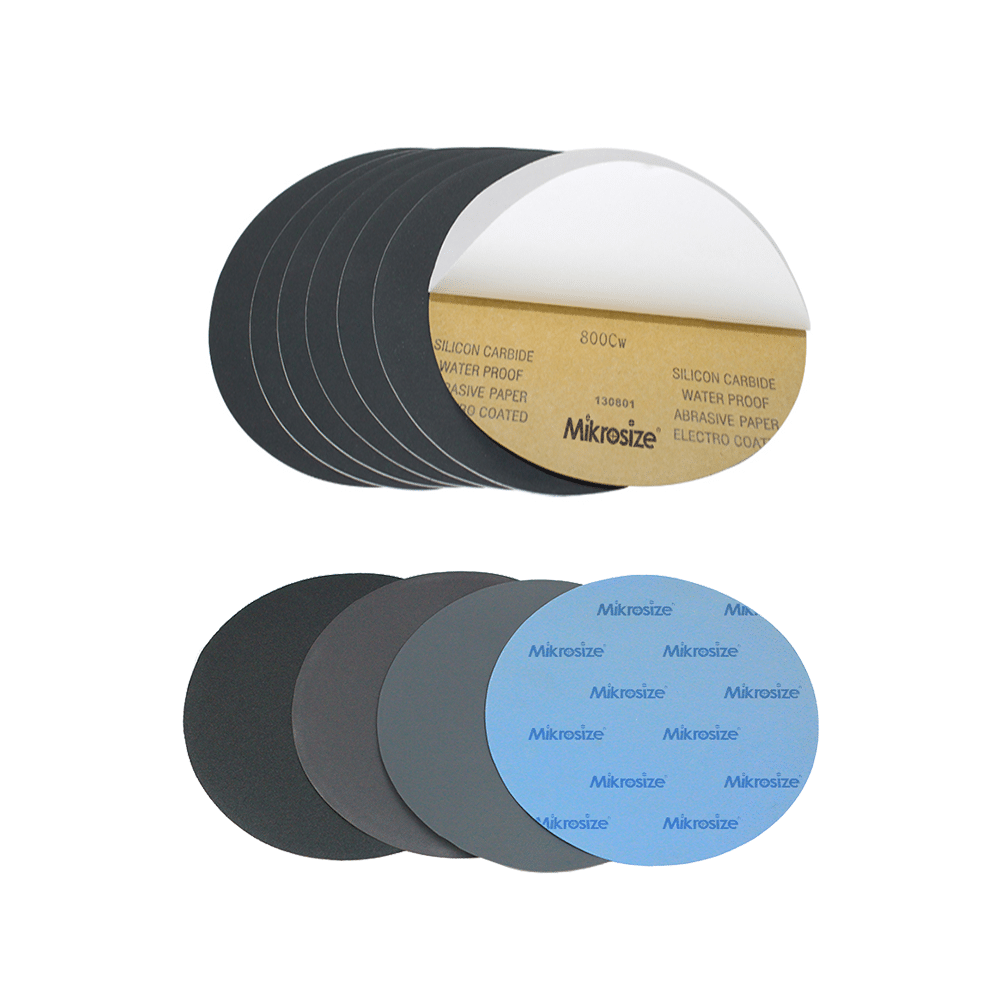
The performance of metallographic sandpaper is determined by three core components—abrasive, substrate and binder—as well as key parameters such as particle size control and flatness. The technical characteristics of each component directly affect the sample preparation effect and service life, and also serve as the core markers distinguishing professional metallographic sandpaper from ordinary industrial sandpaper.
(I)Abrasive: Determining Cutting Efficiency and Scratch Quality
As the core functional component of metallographic sandpaper, the abrasive’s material, purity, sharpness and particle size distribution directly dictate the grinding efficiency, scratch thickness and sample surface quality. At present, the abrasives commonly used in metallographic sandpaper are mainly divided into three categories, each suitable for specific application scenarios:
- Silicon Carbide (SiC): The most widely used general-purpose abrasive with a Mohs hardness of 9.5. Featuring high hardness and sharp cutting performance, it is suitable for grinding an overwhelming majority of metallic and non-metallic materials such as steel, aluminum, copper and titanium alloys. It is particularly applicable to wet grinding processes, effectively reducing sample burn, and is the preferred abrasive for the entire process of rough, medium and fine grinding in metallographic sample preparation. High-quality silicon carbide abrasive requires a purity of ≥98%, with no impurities and regularly shaped particles. It is not prone to cracking during cutting and can produce uniform and fine scratches.
- Aluminum Oxide (Al₂O₃): Slightly lower in hardness than silicon carbide (Mohs 9.0), but with better toughness and wear resistance. It is suitable for grinding high-hardness metallic materials (e.g., cast iron, alloy steel) and especially for dry grinding processes, which can effectively avoid sample contamination caused by abrasive particle shedding during wet grinding.
- Diamond: An ultra-hard abrasive (Mohs 10.0), mainly used for fine grinding of ultra-hard materials (e.g., ceramics, cemented carbide, superalloy) and pre-polishing treatment. It offers extremely high cutting efficiency and produces ultra-fine scratches, enabling the achievement of an ultra-precise surface with Ra≤0.02μm. However, its high cost restricts its application to high-end and stringent sample preparation scenarios.
The particle size distribution of the abrasive is a key indicator. Professional metallographic sandpaper must strictly control the particle size uniformity (≥95% as required by national standards) to avoid particle agglomeration and uneven particle size, which would otherwise cause scratches of varying depths on the sample surface and increase the difficulty of subsequent polishing.
(II) Substrate: Ensuring Flatness and Service Stability
As the carrier of abrasives, the substrate’s flatness, strength, water resistance and flexibility directly impact the user experience of sandpaper and the consistency of sample preparation. Substrates for metallographic sandpaper are mainly divided into paper and cloth substrates, with paper substrates being the most widely used:
- 1.Paper substrate: Classified into ordinary and water-resistant paper substrates. Ordinary paper substrates are only suitable for dry grinding, while water-resistant paper substrates, processed with special techniques, have excellent water resistance and strength, applicable to wet grinding—the mainstream process in metallographic sample preparation—and are not prone to warping, damage or delamination. High-quality paper substrates feature uniform thickness (tolerance ≤0.1mm), good rigidity when placed flat, and resistance to fracture after repeated bending, meeting the high-speed operation requirements of automatic grinding and polishing machines.
- Cloth substrate: Boasting better toughness and wear resistance, it is suitable for manual grinding or large-area, high-intensity grinding. However, its flatness is slightly inferior to that of paper substrates, so it is mostly used in industrial rough grinding scenarios and rarely applied in fine metallographic grinding.
(III) Binder: Determining Abrasive Adhesion and Service Life
The binder serves to firmly fix abrasives on the substrate surface. Its bonding strength, water resistance and high-temperature resistance directly determine the sandpaper’s service life and the possibility of abrasive shedding—a major taboo in metallographic sample preparation, as shed abrasive particles can embed into the sample surface, causing contamination and affecting the results of microscopic observation.
Binders commonly used in metallographic sandpaper include resin binders and animal glue binders. Resin binders (divided into phenolic resin and epoxy resin) with high bonding strength, water resistance and high-temperature resistance, and low risk of abrasive shedding, are the first choice for high-quality metallographic sandpaper. Animal glue binders, with low bonding strength and poor water resistance, are only used in ordinary dry sandpaper and not suitable for wet metallographic grinding processes. High-quality resin binders must have good permeability to form a tight bond with abrasives and substrates, without air bubbles or delamination during grinding, and can keep abrasives firmly attached even after being rubbed in water.

-150x150.jpg)