
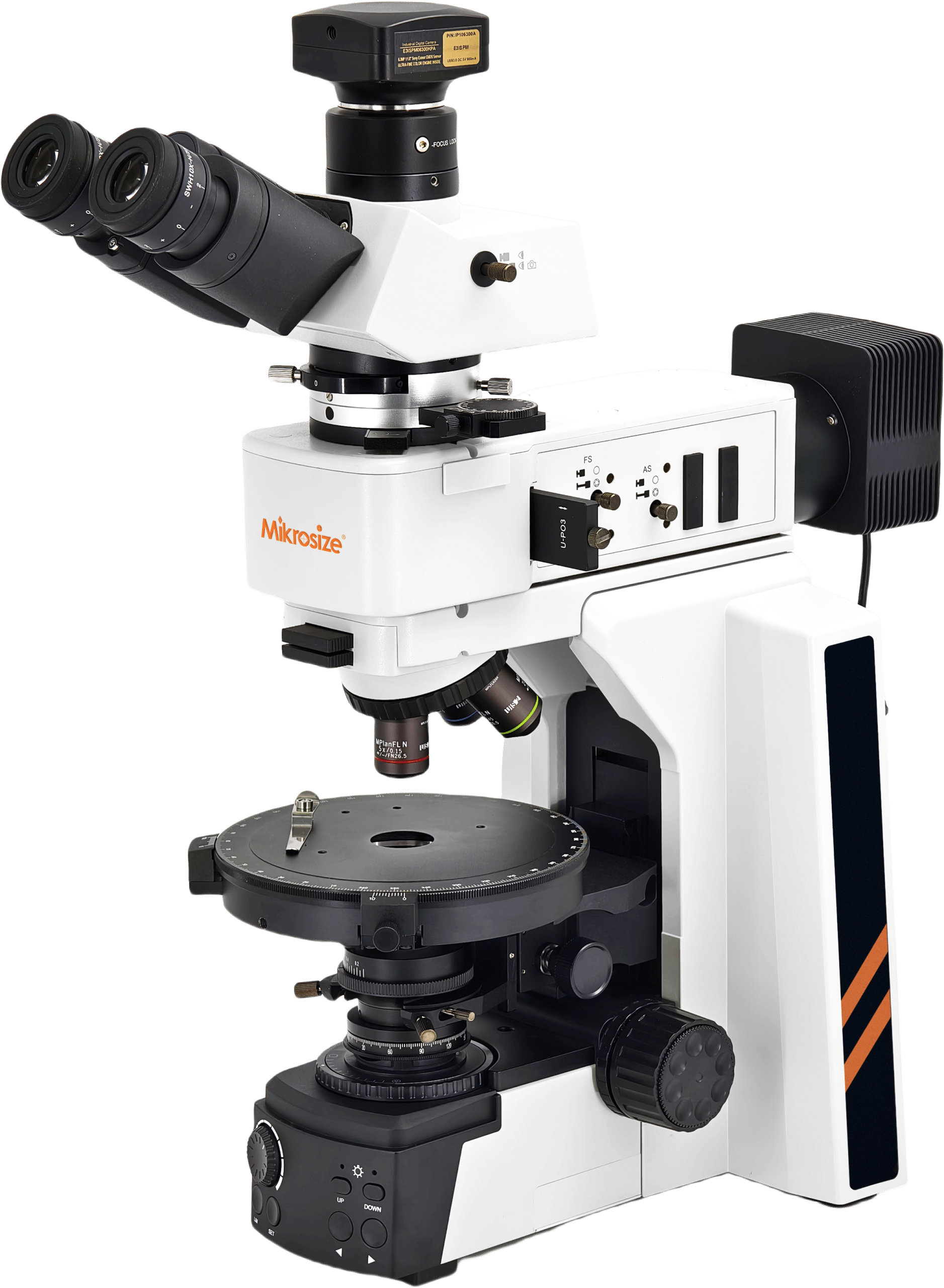
iPLM-43 Polarizing Microscope
Scan QR
Scan QR
.jpg)
.jpg)
.jpg)
.jpg)
.jpg)
iPLM-43 Polarizing Microscope(1)
iPLM-43 Polarizing Microscope(2)
iPLM-43 Polarizing Microscope(3)
iPLM-43 Polarizing Microscope(4)
iPLM-43 Polarizing Microscope(5)
iPLM-43 Polarizing Microscope(6)
Product Features & Applications
Product Feature:
- The T-shaped roof and modular structure are adopted, which is highly rigid, stable and can be flexibly disassembled. The special surface treatment not only enhances aesthetics but also provides practicality. Moreover, it optimizes the concentrated lighting system for energy conservation and environmental protection.
- The reflective illuminator features preset slots and multiple optical components. The polarizer can be removed, enabling both natural light observation and convenient component replacement to meet various needs.
- A 160mm large-diameter graphite-coated worktable with 360° smooth rotation and real-time locking function. Special silk-screened scale lines are used to prevent wear and fading over long-term use.
- A large-aperture telescopic achromatic condenser lens, with adjustable center and elevation, and equipped with a diaphragm, provides sufficient and uniform illumination for observation at various magnifications and photography, resulting in clear images.
- The low-hand position coarse-fine coaxial focusing mechanism, equipped with multiple adjustment and limit devices, provides a comfortable operation. It also enables quick switching of slides and protects the slides as well as the objective lens.
- Integrating hardware with image analysis software, it supports automatic magnification calibration and brightness memory. Combined with professional condenser observation components, it offers precise measurement and efficient observation.
Product Application:
- Geological field: Facilitates the observation of optical properties of rock thin sections, helps in the identification of minerals, and analyzes the structure of rocks and their formation environments.
- Chemical industry: Capable of detecting the crystal phase of liquid polymer materials, assisting in controlling material performance and production quality.
- Research and teaching: Research institutions and universities can utilize this to conduct experimental teaching, thereby cultivating students’ abilities in microscopic observation and material analysis.
Technical Specifications
| Optical system | Infinite distance chromatic aberration correction optical system. |
| Observation tube | 30° tilt, infinite distance hinge three-way eyepiece, interpupillary distance adjustment: 50mm - 75mm, unilateral viewing adjustment: ±5 diopters, two-stage spectral ratio R:T = 100:0 or 50:50. |
| Eyepiece | High-eye-level wide-field flat-field eyepiece SWH10X23mm. The viewing angle is adjustable. It can be equipped with a micrometer scale and a grid plate. |
| Objective lens | Infinity-long working distance stress-relieving flat-field objective lenses of 5X, 10X, 20X, and 50X (semi-compensated chromatic aberration correction). |
| Infinite distance stress-relieving flat-field objective lenses: 4X, 10X, 20X, 40X, 60X. | |
| Focus adjustment mechanism | Low-position coarse-fine coaxial focusing mechanism. Travel (focusing range) 28mm, fine adjustment accuracy 0.001mm. Equipped with a tension adjustment device to prevent sliding and an upper limit position device to prevent damaging the sections. |
| Converter | Internal positioning 5-hole adjustable center converter (one of the holes is fixed). |
| Intermediate lens group | Equipped with a push-pull type deviation detection unit, which can be removed from the optical path; internally contains a Bauschleit mirror, and a turntable-type switching mechanism (with adjustable center and focal length). |
| Bias-correcting mirror group | Bias correction mirror group, 360° rotation, resolution 2°, accuracy 6′, with locking mechanism. |
| Compensator | λ plate: φ18 mm, Grade 1 Red (wavelength difference 551 nm), λ/4 plate: φ18 mm (wavelength difference 147.3 nm), quartz wedge (grades I - IV). |
| Workbench | Rotating metal work platform, surface graphite spraying, anti-corrosion and wear-resistant; diameter 160mm, 360° rotation possible, graduation value 1°, accuracy 6′, equipped with locking device. |
| Collimator | Swing-out type achromatic collimating mirror with N.A. 1.2. |
| Lighting system | Upper lighting: Reflective lamp chamber 10W LED, preset center, reflective illuminator, with field-of-view diaphragm and aperture diaphragm, including LBD color filter set, with plug-in polarizer set. |
| Description: 10W LED transmission lamp chamber, preset center, Cora Lighting, with variable field-of-view diaphragm. | |
| Other attachments | Photography and video accessory: 1X, 0.65X, 0.5X C interface, adjustable focus. |
| 4K high-definition imaging system, USB3.0 computer version imaging system, cameras (5 million, 6 million, 12 million, 20 million, etc.) | |
| High-precision micrometer, with a graduation value of 0.01mm. | |
| Software (professional measurement system, metallographic analysis system, particle analysis system, porosity analysis system, welding-specific measurement system, etc.). |
-1.jpg)
-2.jpg)
.jpg)
.png)
.jpg)
.png)
Contact Us
Get in touch for product information, quotes, or technical support
Call us
+86-0553-2836939
Email us
mikrosize@mikrosize.com