.jpg "What is the K value in Brinell hardness? 1")
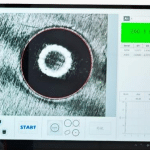
The core principle of the Brinell hardness test is as follows: a hardmetal ball (indenter) of a specified diameter is pressed vertically into the surface of a test specimen under a defined test force, held for a specified time, and then the test force is removed. The diameter of the indentation formed on the specimen surface is measured, and the Brinell hardness value is calculated from the ratio of the test force to the indentation area.
-213x300.jpg "What is the K value in Brinell hardness? 2")
-214x300.jpg "What is the K value in Brinell hardness? 3")
-214x300.jpg "What is the K value in Brinell hardness? 4")
The K value is the key ratio linking the test force (F) and the indenter diameter (D). Mathematically, it is defined as the ratio of the test force to the square of the indenter diameter:
K = F / D²
To unify results under different test conditions, both international standards (ISO 6506 series) and Chinese national standards (GB/T 231.1-2018 Metallic materials—Brinell hardness test—Part 1: Test method) specify that the standardized expression of the Brinell hardness test shall include a unit conversion coefficient. The final standardized formula is:
K = 0.102×F / D² where F is in newtons (N) and D is in millimeters (mm).The core significance of this formula is that, by fixing the K value, indentations formed on the same material with different indenter diameters and test forces maintain geometric similarity (i.e., consistent indentation shape and proportions). This ensures Brinell hardness values measured under different conditions are directly comparable and traceable.
As long as the K value is fixed, measurements using different indenter diameters and test forces are equivalent to measuring material hardness with the same “ruler”, eliminating errors caused by inconsistent test conditions. Conversely, arbitrary K values produce indentations of widely varying shapes and sizes, resulting in non-comparable hardness values that cannot be used to evaluate material properties.
-98x300.jpg "What is the K value in Brinell hardness? 5")
Standard specifications and compliant combinations of Brinell hardness K value
To cover testing for materials ranging from very soft non-ferrous metals (e.g., lead, tin) to hard steels (e.g., high-strength alloy steels, cast irons), and to accommodate practical conditions such as specimen thickness and size, international and domestic standards specify six fixed standard K values: 30, 15, 10, 5, 2.5, 1. These six values are validated by long-term testing and derived from material mechanical properties and industrial practice, maximizing accuracy and validity for specimens of varying hardness and thickness.
In practical testing, the K value, indenter diameter (D), and test force (F) must strictly follow the principle of fixed K value with matched three parameters to form standardized test combinations. The most commonly used standard combinations in industry are listed below (unit: D in mm, F in kgf, with converted newtons (N) in parentheses):
- K=30(most widely used; for medium-to-high hardness materials):D=10mm→F=3000kgf(29420N);D=5mm→F=750kgf(7355N);D=2.5mm→F=187.5kgf(1839N);D=1mm→F=30kgf(294N)。
- K=15(for medium-hardness materials, or thinner medium-to-high hardness specimens):D=10mm→F=1500kgf(14710N);D=5mm→F=375kgf(3678N);D=2.5mm→F=93.75kgf(919N)。
- K=10(for medium-hardness non-ferrous metals, e.g., aluminum alloys, copper alloys):D=10mm→F=1000kgf(9807N);D=5mm→F=250kgf(2452N);D=2.5mm→F=62.5kgf(613N)。
- K=5(for softer non-ferrous metals or thin specimens):D=2.5mm→F=31.25kgf(306N)(the standard combination “5/31.25” mentioned earlier);D=1mm→F=5kgf(49N)。
- K=2.5、1(for very soft metals, e.g., lead, tin, zinc alloys, or ultra-thin specimens):K=2.5,D=2.5mm→F=15.625kgf(153N);K=1,D=2.5mm→F=6.25kgf(61N)。
.jpg "What is the K value in Brinell hardness? 6")
.jpg "What is the K value in Brinell hardness? 7")
It is emphasized that standards explicitly prohibit non-fixed K value test combinations. Test results from non-compliant combinations are invalid and non-traceable, and cannot be used for quality evaluation.
-150x150.jpg)