How to Choose a Metallographic Microscope for Semiconductor Industry?
In the field of semiconductor inspection, there is no best metallurgical microscope—only the most suitable one.
In the semiconductor industry, we technical professionals often face a soul-searching question: how to choose a reliable yet cost-effective metallographic microscope? Today, Mikrosize share some insights to tackle this headache-inducing purchasing dilemma.
When selecting a metallographic microscope, it is recommended to focus on three key aspects:
The imaging quality should be excellent – in the semiconductor field, a good lens is worth a thousand words. The core depends on whether it supports multiple observation modes such as bright field, dark field, polarization, DIC, etc., to ensure that the microstructure of the material can be clearly captured.
The cost-effectiveness should be reasonable – not the more expensive the better, but finding a balance between configuration and price. We highly recommend devices that support modular upgrades, so that they can gradually improve their functionality according to their needs in the later stage, avoiding excessive one-time investment.
After sales service needs to be excellent – it is very important to be able to respond quickly when equipment problems occur. It is recommended to choose a brand that provides at least 2 year of free maintenance and a response time of no more than 48 hours, which can effectively avoid affecting the research and development progress due to equipment downtime.
Mikrosize vs Olympus
Olympus: If you have a sufficient budget and pursue ultimate imaging, Olympus maybe the first choice. Its apochromatic optical system is indeed excellent, maintaining high consistency from the center to the edges of the image. However, the price is “high-end”, with the main models costing over 12000USD.
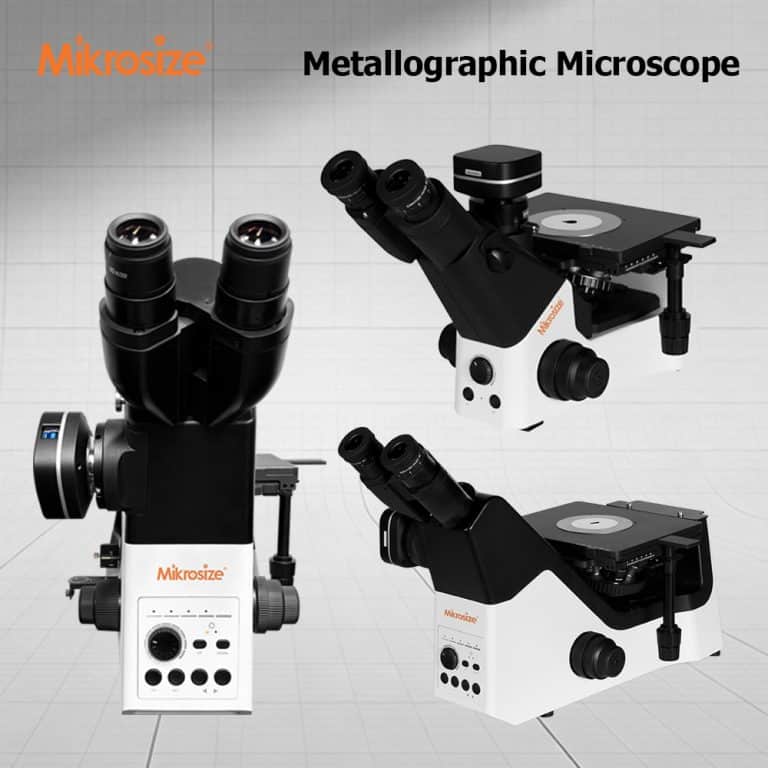
Mikrosize:What attracts customer the most about this brand is its modular design and customization capabilities. The main models prices are very affordable and support flexible upgrades in the future. Our quality inspection department has customized a specialized observation module based on actual needs, which not only meets research needs but also controls costs.
On demand selection guide:
High end R&D: Choose Olympus directly, its imaging accuracy is worthy of its price
Multi scenario applications with limited budget: Focus on Mikrosize, whose modular design of metallographic microscopes allows you to configure them as needed, avoiding functional waste and offering high cost-effectiveness
Last but not least:After practical use, our experience is that in the field of semiconductor testing, there is no best metallographic microscope, only the most suitable one. If you consider performance, price, and future support comprehensively, Mikrosize is indeed a good choice. Its modular approach is very practical, allowing us to gradually improve equipment functions based on actual research progress. This flexibility is very friendly to researchers.
I hope these experiences can help you who are worried about choosing a metallographic microscope. After all, choosing the right tool is half the battle for success.
-150x150.jpg)