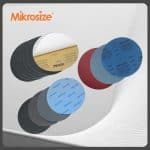
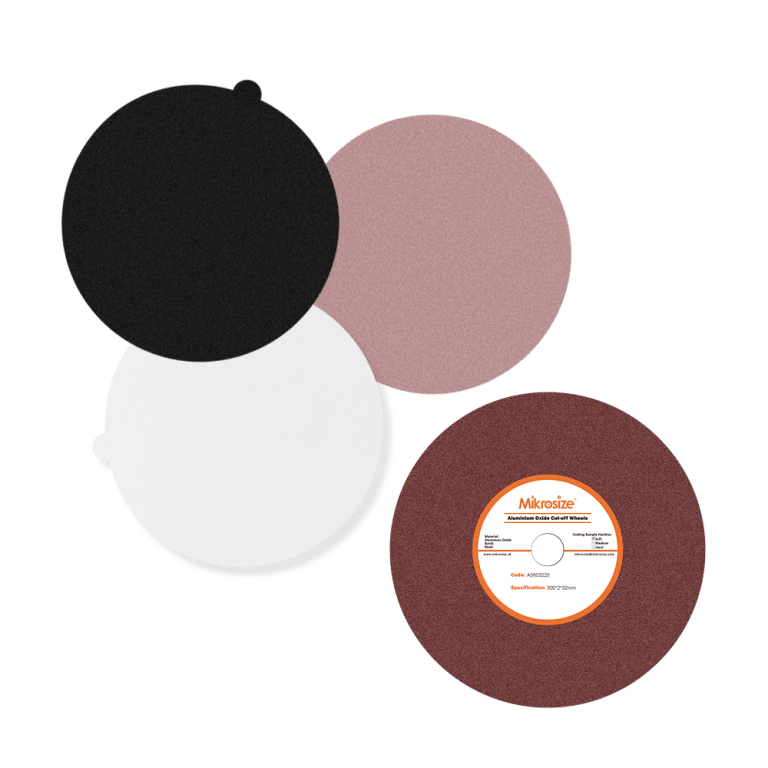
The core of metallographic sample preparation is “from coarse to fine, gradual refinement”. Abrasive paper of different grit sizes serve distinct purposes and must be strictly selected according to the sample preparation stage, with no skipping of grit grades – otherwise, sample preparation will fail. The following are the most commonly used abrasive paper grit sizes in daily work and their corresponding applications:
(1) Coarse Grinding Stage: Grit P80~P240
Its core purpose is to quickly remove the cutting allowance and burrs of the sample, level the sample surface, and eliminate the deep scratches caused by cutting.
Among them, P120 and P240 are the most commonly used coarse grinding sandpapers:
- P80 is a relatively coarse grit, suitable for samples with a large cutting allowance; it features high cutting efficiency but leaves deep scratches.
- P120 and P240 are medium-coarse grits that can not only remove material quickly but also reduce the workload of subsequent intermediate grinding, making them the first choice for coarse grinding of conventional samples.
(2) Intermediate Grinding Stage: Grit P400~P800
Its core purpose is to eliminate the deep scratches left by coarse grinding, gradually refine the sample surface, and lay the foundation for fine grinding.
Among them, P600 and P800 are the most commonly used intermediate grinding sandpapers:
-
- P400 is suitable for samples with deep scratches after coarse grinding.
- P600 and P800 are suitable for samples with a relatively flat surface after coarse grinding; the sample surface after grinding has uniform and fine scratches, which can lay a solid foundation for fine grinding.
(3) Fine Grinding Stage: Grit P1200~P2500
Its core purpose is to further refine the scratches on the sample surface to make the surface flat and smooth, preparing for subsequent polishing – this is the final grinding stage for conventional metallographic sample preparation.
Among them, P1200, P2000 and P2500 are the most commonly used fine grinding sandpapers:
- P1200 is suitable for samples with relatively obvious scratches after intermediate grinding.
- P2000 and P2500 are suitable for samples with high surface quality requirements; the sample surface after grinding has extremely fine scratches, and a mirror finish can be obtained quickly through polishing.
- As the official upper limit specified in FEPA (European Federation of Abrasive Producers) and national standards, P2500 can meet the fine grinding requirements of the vast majority of conventional metallographic sample preparation.
(4) Ultra-fine Grinding Stage: Grit P3000~P4000 (custom extended by manufacturers)
Its core purpose is ultra-precision grinding for obtaining an ultra-smooth surface with Ra<0.02μm, suitable for high-end scenarios with extremely high surface quality requirements such as high-end metallography, semiconductors and optical components.
It is not required for daily conventional sample preparation (e.g., ordinary steel and aluminum samples) and only needs to be used after P2500 for ultra-fine grinding when a mirror finish and a deformation-free layer are required.
Supplementary Reminder
The selection of sandpaper grit size can be appropriately adjusted for samples of different materials:
- For high-hardness metals (e.g., cast iron, alloy steel), the grit grade can be appropriately reduced (e.g., P120 for coarse grinding and P400 for intermediate grinding) to avoid excessively low cutting efficiency.
- For ordinary metals (e.g., steel, aluminum), the conventional grit sizes mentioned above can be directly adopted.
-150x150.jpg)