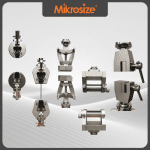
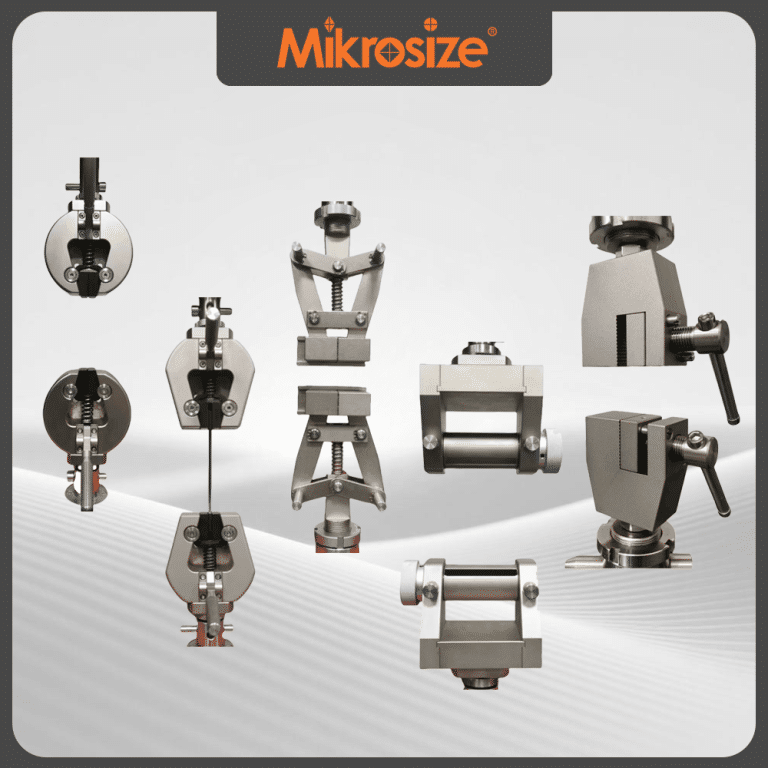
For test specimens of different materials and in compliance with various test standard requirements, it is essential to select appropriate fixtures. Generally, fixtures serve three core functions in material tests:
- Prevent slippage of the test specimen.
- Avoid fracture of the test specimen at the jaw.
- Ensure centering of the test specimen.
Fixtures can be simply classified into three types: manual fixtures, pneumatic fixtures and hydraulic fixtures. Manual fixtures have the widest range of applications; pneumatic fixtures are recommended for tests under 10 kN for more stable test data; for high-force tests, sufficient clamping force is required, so hydraulic fixtures are usually selected for high-strength and large-size test specimens.
In the process of material mechanical property tests, including tension, compression, bending and other experiments, fixtures are core components that ensure accurate test data, stable test procedures and uniform stress on test specimens. For test specimens with different materials, dimensions, test force magnitudes and in accordance with distinct test standard requirements, the corresponding fixture types and clamping surface structures must be matched. Otherwise, problems such as slippage, abnormal fracture positions, large data deviations and eccentric stress on specimens will easily occur, directly affecting the validity and repeatability of test results.
The core functions of fixtures in tests are mainly reflected in three key aspects:
1.Prevent slippage of the test specimen:
Insufficient clamping force or poor matching of clamping surfaces will cause the test specimen to slip during the test, leading to abnormal force curves and inaccurate elongation measurement, and ultimately invalid data. A qualified fixture must provide stable and uniform clamping force to keep the specimen fixed throughout the stress application process.
2.Avoid fracture of the test specimen at the jaw:
Stress concentration is most obvious at the jaw. Excessively tight clamping, overly rough clamping surfaces or uneven stress will easily cause the specimen to fracture at the jaw instead of the gauge length section required by the standard. Such test results are non-compliant and the test must be repeated.
3.Ensure accurate centering of the test specimen:
Eccentricity or inclination of the specimen during clamping will generate additional bending moment during tension, resulting in the “eccentric tension” phenomenon, which leads to large data fluctuations and high dispersion, and fails to truly reflect the inherent mechanical properties of the material. Therefore, centering is a basic requirement for clamping.
Selection of Fixture Types (by Drive Mode)
Fixtures are usually divided into three categories by drive and clamping mode: manual fixtures, pneumatic fixtures and hydraulic fixtures, each with distinct applicable scenarios:
1.Manual fixtures
They feature the widest application and strong versatility, with a simple structure, easy operation and low cost. Suitable for low-force tests, conventional specimens and daily batch testing in laboratories, manual fixtures are the first choice for most conventional material tests under 10 kN, meeting basic clamping needs with simple maintenance.
2.Pneumatic fixtures
Suitable for low to medium force tests under 10 kN, they are driven by air pressure for clamping, providing uniform and consistent clamping force. They can greatly reduce errors caused by uneven manual clamping force, making test data more stable and repeatable, and are thus suitable for standardized tests with high requirements for data accuracy.
3.Hydraulic fixtures
Designed specifically for high-force tests and high-strength, large-size specimens, they rely on a hydraulic system to provide large clamping force, ensuring stable clamping and reliable locking. Capable of handling difficult-to-clamp specimens such as metal plates, bars and high-strength composite materials, they prevent slippage and loosening under high test forces, and are the standard configuration for large-tonnage testing machines.
Selection of Clamping Surfaces (by Specimen Material and Shape)
Clamping surfaces are in direct contact with test specimens, and their structure is determined by the material, hardness and cross-sectional shape of the specimens. An incorrect selection will directly lead to jaw fracture, slippage and specimen damage caused by clamping:
1.Serrated clamping surfaces
Suitable for hard specimens with smooth surfaces that hardly fracture at the jaw, such as ordinary metals and rigid plastics. The serrated structure can enhance the occlusal capacity and prioritize slip prevention, applicable to most conventional rigid materials.
2.V-shaped clamping surfaces
Exclusively designed for round bars, pipes and wires, the V-shaped groove enables automatic centering and wrap-around clamping, increasing the contact area and clamping force, preventing rolling and eccentricity of round specimens and ensuring stable clamping.
3.Smooth clamping surfaces
Suitable for brittle specimens and those prone to clamping damage or jaw fracture, such as brittle plastics, films and some metal foils. The smooth surface has no sharp teeth, avoiding surface damage to the specimen, reducing stress concentration and lowering the probability of jaw fracture.
4.Rubber clamping surfaces
Specially designed for soft specimens, elastomers, films, leather, rubber and other materials, the soft rubber material will not damage the specimen or bite through its surface during clamping, while increasing friction to solve the problems of difficult clamping and easy slippage of soft specimens.
Basic Principles for Specimen Clamping and Centering
1.Clamping length requirement
During clamping, the effective length of the specimen extending into the jaw should be at least 3/4 of the total height of the clamping surface, ensuring a sufficient contact area to avoid uneven stress, slippage or fracture caused by insufficient clamping depth.
2.Specimen centering requirement
Centering cannot be judged by the naked eye alone; special auxiliary tools such as dedicated centering tools, centering baffles and guiding devices must be used to ensure that the center line of the specimen is completely aligned with the stress axis of the testing machine and eliminate eccentric bending moment.
3.Clamping force control
Manual fixtures should not be over-tightened to avoid specimen damage; the pressure of pneumatic/hydraulic fixtures needs to be adjusted according to the specimen material—appropriately increase the pressure for hard specimens and reduce the pressure for soft/brittle specimens, following the standard of “firm clamping without slippage or damage”.
-150x150.jpg)