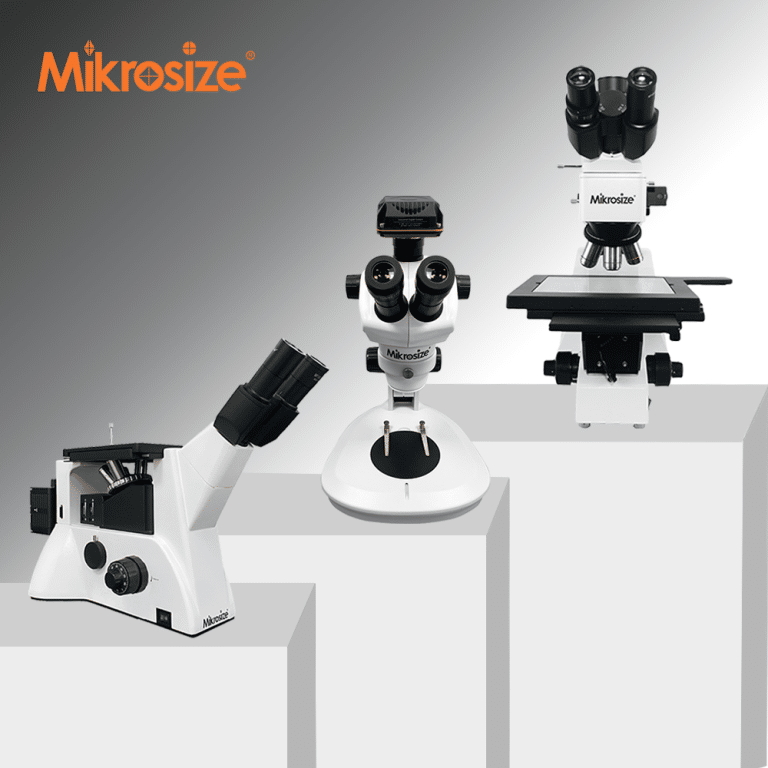
The core differences between stereo microscopes and optical microscopes lie in imaging mode, magnification, and application scenarios: stereo microscopes form three-dimensional images through dual light paths, suitable for macroscopic three-dimensional observation; optical microscopes adopt single light path planar imaging, specializing in microscopic structure analysis.
Comparison Table
| Comparison Dimensions | Stereo Microscope | Optical Microscope |
| Imaging Principle | Dual-light-path stereo imaging | Single optical path planar imaging |
| Magnification | 4-160 | 4-1000 |
| Resolution | 100-200um | 0.2um |
| Operation Features | Erect image with a long working distance. | Inverted image requires precise focusing |
| Sample Requirements | No need to make glass slides, direct observation | Need to make glass slides |
Application of Stereo Microscope
1.Industrial inspection: Circuit board soldering, jewelry identification (three-dimensional observation of surface structures).
2.Biological dissection: Insect specimens, plant tissues (large depth of field + stereoscopic vision)
3.Teaching demonstration: Experiments for primary and secondary school students (simple operation, intuitive imaging)
Applications of Optical Microscope
1.Medical Research: Cell observation, pathological sections (high resolution)
2.Materials Science: Metallographic analysis (ultra-high magnification)
3.Microbiology: Observation of bacteria and viruses
Purchasing Suggestion:
Functional verification:
Check if the zoom range is continuous (key indicator of stereo microscope)
Test the homogeneity of the objective lens (core parameter of optical microscope)
Question and Answer:
Q: Can cells be observed under a stereo microscope?
A: Not recommended. Its resolution is insufficient (200 microns), making it impossible to see the cell structure clearly.
Q: Why does an optical microscope require staining?
A: Enhance contrast. Transparent samples are difficult to identify details under transmitted light.
Q: Which one is more suitable for household use?
A: Stereoscopic microscopes (such as children’s science kits)
-150x150.jpg)